P2P Fraud Cases: Key Lessons and the Role of AI for Early Detection in the Fintech Industry


Indonesia's P2P lending industry continues to grow rapidly, particularly in productive sectors like agriculture, fisheries, and MSMEs. However, this growth brings significant challenges.
Fraud is one of them. The increasingly complex risk of fraud no longer only involves fake borrower data, but also includes manipulation of financial reports, engineering of operational performance, and even revenue inflation.
In 2024-2025, Indonesia was shaken by one of the largest fraud cases in the agritech sector, where thousands of P2P transactions were suspected to be inaccurate and did not reflect the actual conditions. From this case, we can learn how fraud patterns occur and why manual systems failed to detect them early.
This article discusses the key lessons from that case, as well as how P2P platforms can strengthen fraud prevention using technology. Such as Simplifa.ai, which combines automated data parsing, anomaly detection, and intelligent financial analysis.
1. Manual Verification Isn't Enough: What Happened in the 2024-2025 Agritech Case
The fraud case in the agritech sector began to unravel after a whistleblower reported irregularities in the company's financial reports. An independent audit subsequently found that:
a. Revenue was inflated by over 70%
A third-party audit found that the majority of the reported revenue—over 75%—did not match the actual conditions.
This fraudulent activity went on for more than 9 months, deceiving everyone from investors to funding partners.
b. Two report versions: internal vs external
The audit investigation also uncovered a dual reporting system, where the reports for the public and investors were significantly different from the internal data.
c. Engineered Operational Figures
The audit uncovered discrepancies in operational costs and manipulated figures. For example, the number of operational units claimed reached hundreds of thousands, but the audit estimated the actual number was only around tens of thousands.
This demonstrates that not only was the financial data manipulated, but also the operational data used as the basis for the P2P applications was inaccurate.
d. Hidden Massive Losses
Internal reports showed the company was experiencing losses of hundreds of millions of dollars. However, the public reports created the impression that the business was growing rapidly.
e. Manual Processes Failed to Detect Issues Early
The fact that this fraud went on for years (with indications since 2018) shows that document-based verification, spreadsheets, and manual oversight are no longer sufficient for a large scale of borrowers.
In the end, this case forced major investors to bring in global auditors like PwC and Grant Thornton to uncover the truth.
2. Lessons for the P2P Industry: Risks No Longer Come Only from Small Borrowers

The agritech case shows that:
⚠️ The biggest fraud actually comes from large borrowers, not individuals
When a borrower entity has thousands of transactions and a vast internal ecosystem, data can be systematically engineered to the point of being difficult to detect.
⚠️ Self-reported reports cannot be fully trusted
This includes spreadsheets, manually uploaded reports, and document photos. Although considered valid, these documents can be manipulated without strict oversight.
⚠️ Verification must be layered and automated.
Human error, workload, and borrower volume often make it impossible for manual checks to detect anomalies, especially those that are neatly concealed.
⚠️ P2P platforms must be able to monitor data consistency over time.
Major fraud does not happen overnight; this case created patterns of suspicious irregularities over a period of months before being uncovered.
3. The Role of AI in Early Anomaly Detection

To prevent similar cases, P2P platforms need technology capable of:
1) Instantly verifying bank statements across multiple banks
Simplifa.ai is capable of processing bank statements from over 100 banks and 200+ types of formats.
This AI-based verification process is extremely helpful when a company needs to:
- assess a borrower's cash flow,
- check income consistency,
- verify if revenue matches claims,
- detect unusual transaction patterns.
2) Automatic anomaly detection in every transaction
Simplifa.ai can detect anomalous transactions, fraud, and perform forecasting, allowing financial irregularities to be flagged immediately. For example:
- sudden revenue surges,
- cash flow inconsistent with seasonal patterns,
- unreasonable expenses,
- spikes in transactions to certain parties,
These are the same patterns that emerged in the agritech fraud case.
3) Unifying financial and operational data into actionable insights
Simplifa.ai provides:
- interactive visualizations,
- LLM-based insights,
- industry benchmarks,
- narrative analysis,
- business forecasting
This allows the P2P risk team to see whether a borrower's performance has genuinely improved or merely appears elevated due to manipulated figures.
4) Automatic scalability for thousands of borrowers
No internal team is capable of manually reviewing thousands of bank statements per month. It is AI-based systems like Simplifa.ai that make this process possible, easy, and accurate.
4. The Future of Indonesia's P2P: From Trust to Digital Verification
The 2024-2025 agritech fraud case serves as a crucial warning for the industry:
Fraud prevention is no longer an optional add-on — it is the foundation for a P2P platform's sustainability.
Investors now demand transparency.
Regulators demand stronger governance.
Honest borrowers are also harmed when the ecosystem is damaged.
For this reason, P2P platforms need technology that can:
- ensure borrower data is valid,
- accurately verify fund flows,
- identify anomalies early,
- minimize the risk of mass defaults.
Simplifa.ai offers infrastructure that supports real-time data verification, automated fraud detection, and unbiased financial insights — its credentials are proven through features like rapid document parsing, specialized AI models, and comprehensive anomaly detection.
Conclusion
The wave of fraud in Indonesia's P2P ecosystem demonstrates that modern risks cannot be prevented with manual SOPs alone. As technology advances, fraud also becomes increasingly complex and varied.
By leveraging AI-based technology, such as Simplifa.ai's automated data verification, anomaly detection, and intelligent analytics, P2P platforms can:
- reduce systemic fraud risk,
- improve borrower quality,
- and build a healthier funding ecosystem.
Without early detection, losses can escalate to the point of damaging trust in the entire industry. Therefore, fraud in the modern age requires modern solutions.
Related Articles

Optimize financial transaction security with machine learning-based bank statement parsing. Learn how to detect anomalies automatically and efficiently.

Every business decision must be carefully considered, especially when it involves financial transactions. In business, besides planning, another crucial aspect is the transactions carried out.
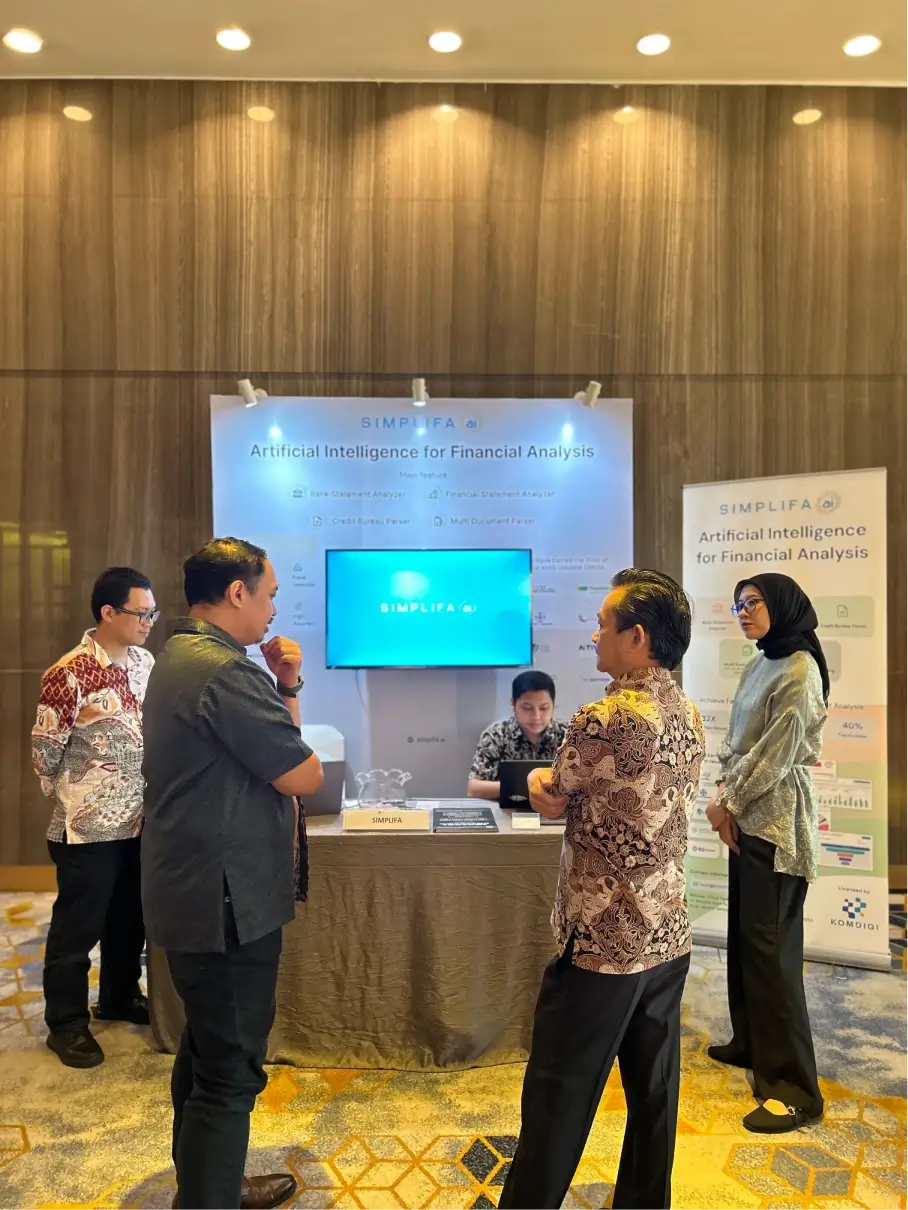
A National Seminar, “Resilience and Turnaround: Indonesia's Economic Direction”, hosted by The Indonesian Financing Companies Association (APPI) held at the Pullman Hotel Thamrin, Jakarta.