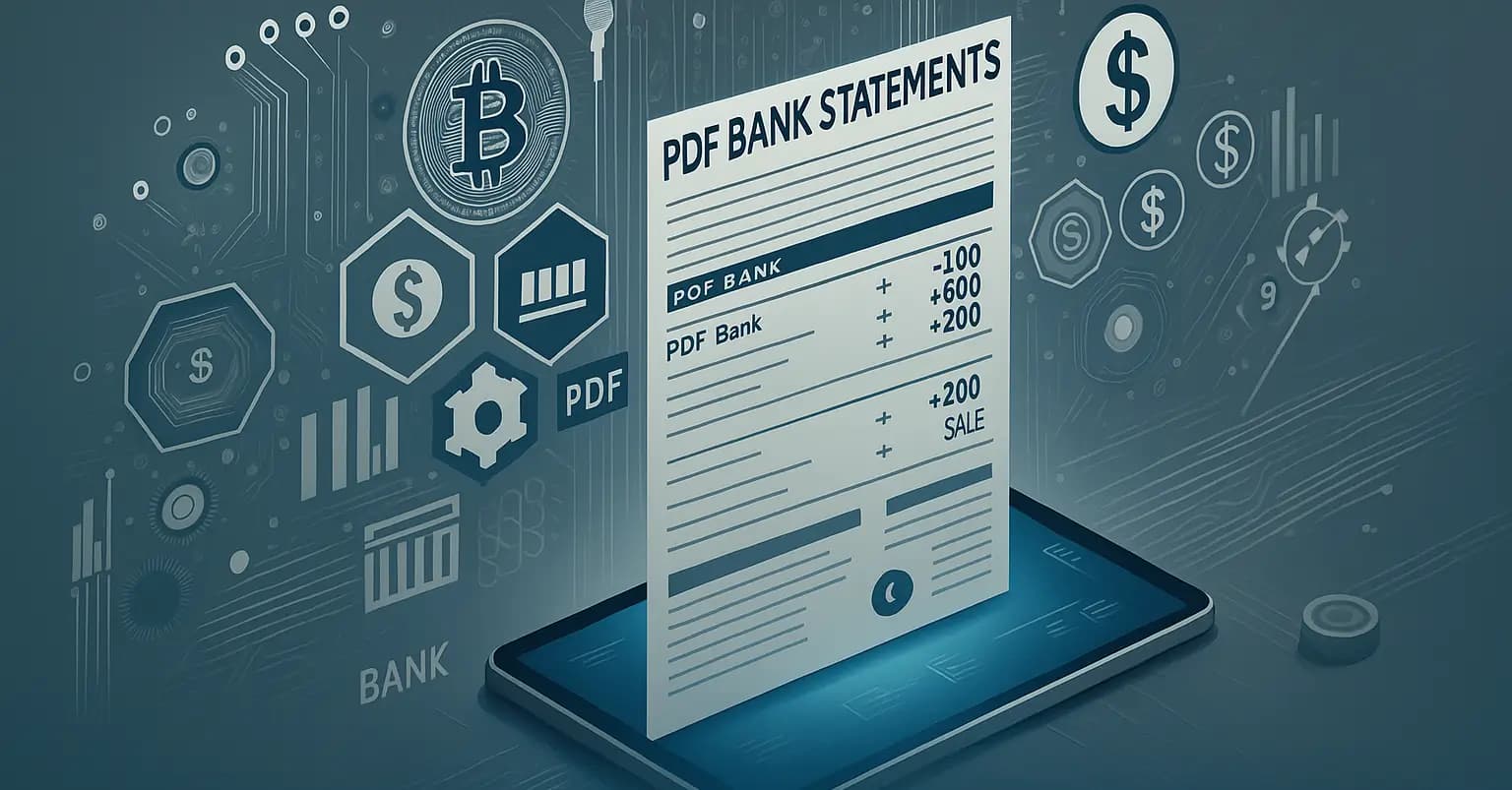
Document Parsing with OCR: When Is It Needed and How Does It Work?
In many organizations, business processes still rely on documents in unstructured formats—scanned PDFs, bank statement reports, invoices, contracts, and manual forms. As document volumes increase, manual data entry becomes slow, error-prone, and difficult to audit.
It is in this context that document parsing with OCR (Optical Character Recognition) becomes relevant. OCR is not merely a tool for reading text from images, but an initial component in the process of converting raw documents into structured data that can be analyzed.
When Is Document Parsing with OCR Needed?
Not all organizations need OCR. This technology becomes crucial when:
1. Document volume is high and repetitive
For example, hundreds of bank statements or invoices per month that need to be reconciled.
2. Documents are available in scanned or non-editable PDF format
Many financial reports and bank statements are still sent in formats that cannot be processed directly.
3. The process requires high consistency and speed
In auditing or credit analysis, delays in data extraction can slow down decision-making.
4. The risk of human error begins to have a significant impact
Errors in data entry, misclassification of transactions, or negligence in reading documents can lead to reporting inaccuracies.
In these scenarios, OCR serves as an initial automation layer before the data is processed further.
How OCR Works Technically
In general, the OCR process consists of several systematic technical stages:
1. Image Pre-processing
Scanned documents often contain noise, shadows, or low contrast. The OCR system performs:
- Contrast enhancement
- Noise removal
- Deskewing (straightening tilted documents)
- Binarization (converting to black and white to optimize reading)
This stage is important because image quality greatly affects character recognition accuracy.
2. Text Detection
The system identifies which areas within the image contain text. In complex documents such as bank statements or tabular reports, this stage includes line and column segmentation.
3. Character Recognition
In this core stage, the algorithm recognizes characters one by one and converts them into digital text. Modern OCR generally uses machine learning or deep learning-based models to improve accuracy, especially on varied fonts.
4. Post-processing
After the text has been recognized, the system performs:
- Dictionary- or pattern-based error correction
- Formatting adjustments for numbers and dates
- Filtering of irrelevant characters
This stage reduces interpretation errors, such as the number "0" being read as the letter "O".
5. Parsing and Data Structuring
OCR produces raw text. To be usable in financial systems, that text needs to be mapped into a data structure. For example:
- Transaction date
- Description
- Debit/credit amount
- Ending balance
This document parsing stage is what distinguishes simple text extraction from an analytics-ready system.
Limitations of OCR
Although helpful, OCR has limitations. It is highly dependent on document quality. The OCR process becomes difficult when encountering several obstacles, including:
- Documents with low scan quality, which reduces accuracy
- Handwriting that is difficult to recognize
- Complex table structures that can cause segmentation errors
- Highly varied formats requiring customized models
Therefore, OCR should be complemented with a data validation and verification layer before being used in analytical or reporting processes.
Why OCR Alone Is Not Enough

OCR converts images into text. However, in the context of finance and auditing, organizations need more than just text. Several other crucial factors are required, for example:
- Data format normalization
- Validation of consistency across transactions
- Integration into risk analysis systems
- Reconciliation across data sources
Without these processes, the OCR output is merely a collection of digital text that is not yet ready to be used for decision-making.
Document parsing with OCR is needed when volume, complexity, and accuracy requirements exceed manual processing capacity. The process involves technical stages ranging from pre-processing to data structuring.
However, the business value does not stop at text extraction. Maximum benefit is achieved when OCR results can be integrated with adequate analytical systems, validation, and internal controls.
OCR is the starting point for document automation; clean and verified data structure is the key to accountable analysis.